Kitchen Countertop Services in Los Angeles

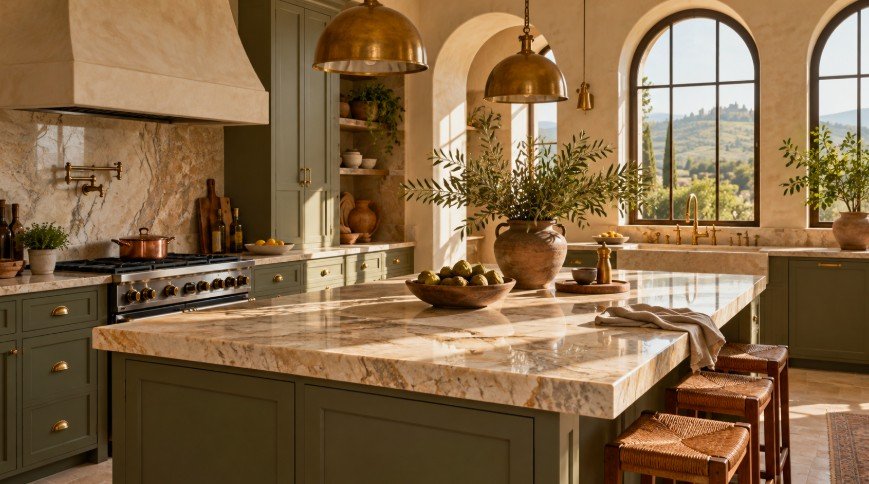
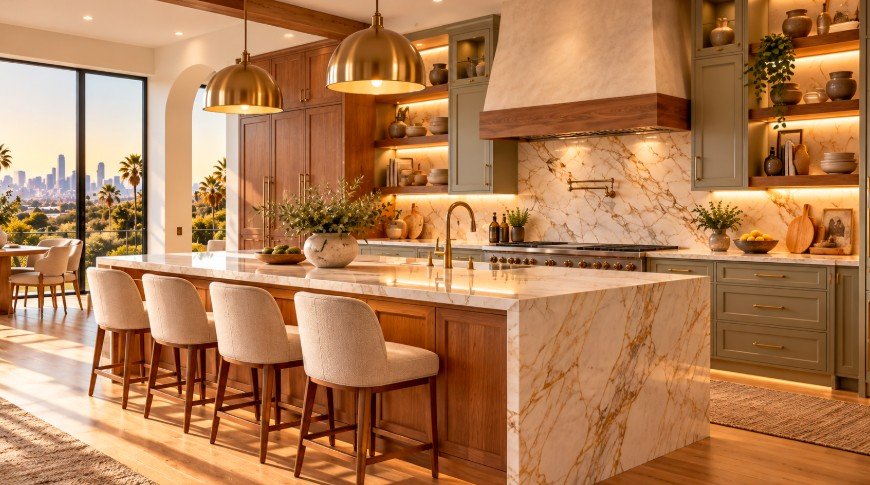
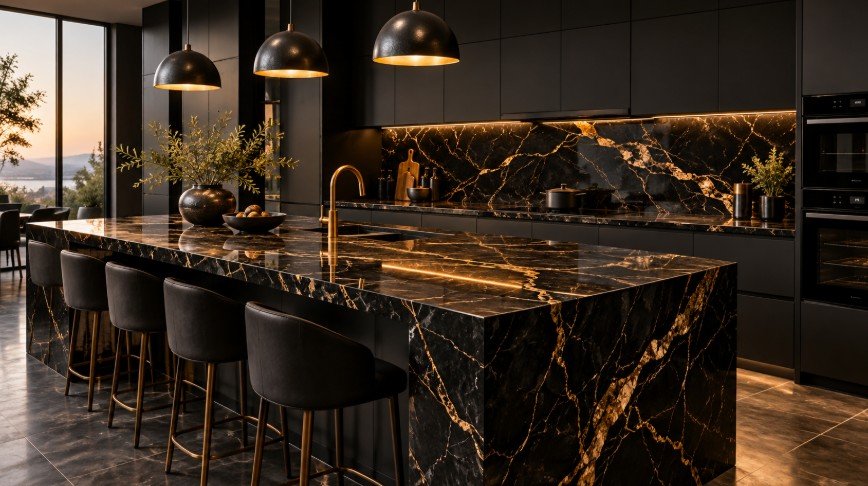
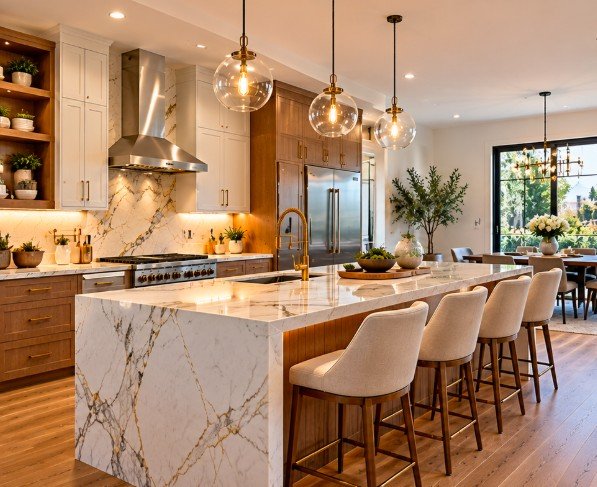
Kitchen countertops are one of the most visible and frequently used surfaces in any kitchen. They affect the appearance of the room, the amount of usable workspace, the durability of the kitchen, and the way surrounding elements such as cabinets, backsplash, sinks, appliances, and lighting come together.

Get a Free Estimate

Tell us about your kitchen. We reply within one business day.

By submitting this form, you agree to our Privacy Policy.

At LA Kitchen Remodeling and Renovation, we provide countertop installation, replacement, repair, and remodeling services for kitchens throughout Los Angeles. Our countertop solutions can be incorporated into a complete kitchen remodel or completed as a focused upgrade when the existing cabinets and layout remain in good condition.

Homeowners can choose from a wide range of materials, including quartz, granite, marble, quartzite, porcelain, butcher block, concrete, solid surface, and laminate. Each material has its own appearance, maintenance requirements, durability characteristics, price range, and design possibilities.

We help plan countertop dimensions, edge profiles, sink openings, faucet placement, appliance clearances, seams, backsplash transitions, island overhangs, and other details so the finished installation works properly with the rest of the kitchen.

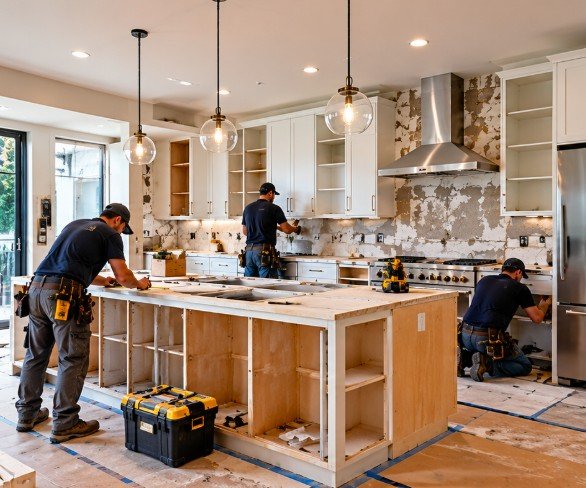
Crew preparing a kitchen island and base cabinets for new countertops

Kitchen Countertop Installation

Professional kitchen countertop installation requires accurate measurements, proper preparation, careful fabrication, and precise placement.

Before installation, the cabinet layout must be reviewed to confirm that the base cabinets are level, securely installed, and capable of supporting the selected countertop material. Sink locations, cooktops, faucets, appliances, backsplash conditions, and countertop overhangs also need to be considered.

Depending on the material, countertop sections may be fabricated off-site using measurements or templates taken from the completed cabinet installation.

During installation, the sections are positioned, leveled, joined, secured, and adjusted as needed. Sink and cooktop openings must align correctly, while seams should be placed strategically whenever possible.

A properly installed countertop should look balanced, provide a reliable work surface, and integrate naturally with the cabinetry and surrounding materials.

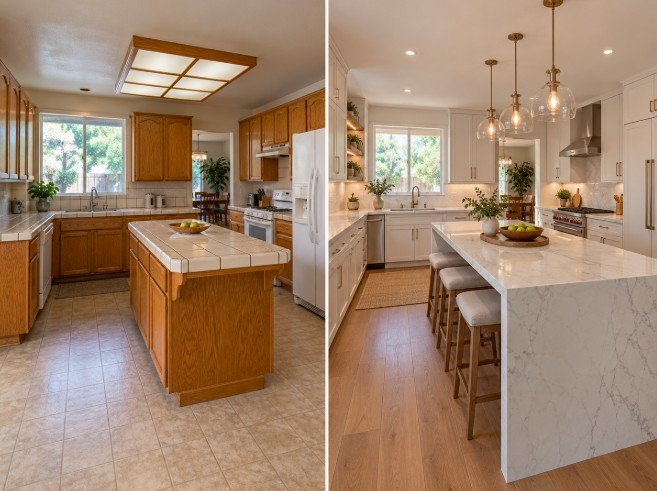
Before: tiled countertops on an oak island. After: quartz waterfall countertop and white cabinetsBeforeAfter

Countertop Replacement

Countertop replacement can dramatically update a kitchen without requiring a complete remodel.

Old countertops may become scratched, stained, chipped, cracked, outdated, or difficult to maintain. Replacing them can improve both the appearance and functionality of the room.

Before removing the existing countertop, the cabinets should be inspected to make sure they are strong enough for the new material. Plumbing connections, sinks, faucets, cooktops, backsplash, and appliances may also need to be disconnected or adjusted during the replacement process.

A new countertop can be paired with an updated backsplash, new sink, modern faucet, under-cabinet lighting, and new cabinet hardware to create a much larger visual transformation.

Countertop materials we install

From engineered quartz to natural stone and warm wood, each surface has its own look, care needs, and price range.

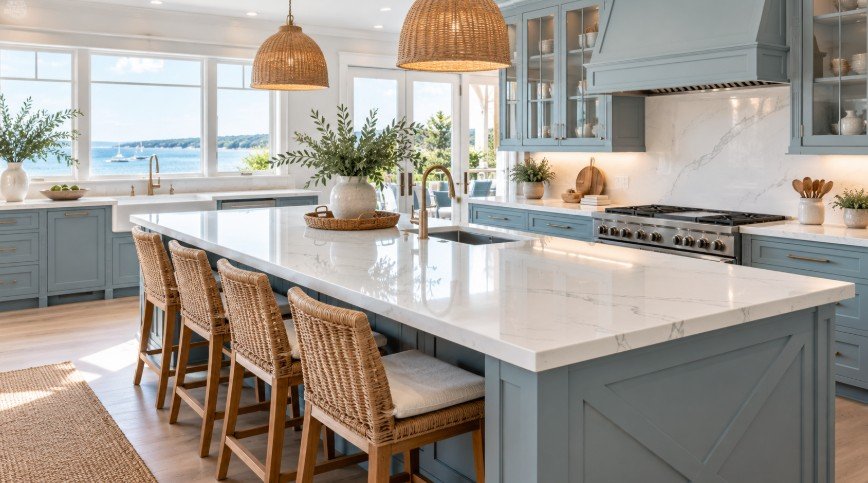
White quartz countertop on a coastal blue island with woven stools
Engineered, nonporous

Quartz Countertops

Quartz countertops are one of the most popular choices for modern kitchen remodeling.

Engineered quartz is manufactured from natural quartz combined with binders and pigments, creating a nonporous surface available in a wide variety of colors and patterns.

Quartz can imitate marble, concrete, limestone, and other natural materials while offering consistent appearance and relatively simple maintenance.

Because quartz is nonporous, it does not usually require sealing. It is also resistant to many common household stains when properly maintained.

Quartz countertops work well in contemporary, transitional, modern, and traditional kitchen designs.

Popular options include bright white quartz, soft gray patterns, dramatic veining, warm neutral colors, and subtle stone-inspired designs.
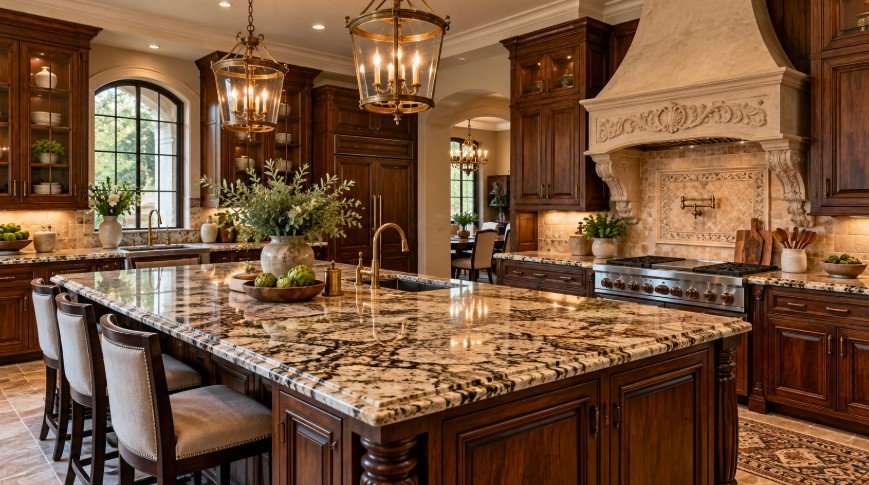
Speckled granite countertop on a traditional cherry wood island
Natural stone

Granite Countertops

Granite countertops are made from natural stone and are valued for their durability, unique patterning, and natural appearance.

Each granite slab is different, with variations in color, movement, mineral deposits, and veining. This makes granite especially appealing to homeowners who want a countertop with genuine stone character.

Granite is available in a wide variety of colors, ranging from light neutrals to dramatic blacks, browns, greens, blues, and multicolored patterns.

Natural granite generally requires sealing to help protect the surface from staining.

When properly selected and maintained, granite can provide a durable work surface for everyday kitchen use while adding a distinctive visual element to the room.

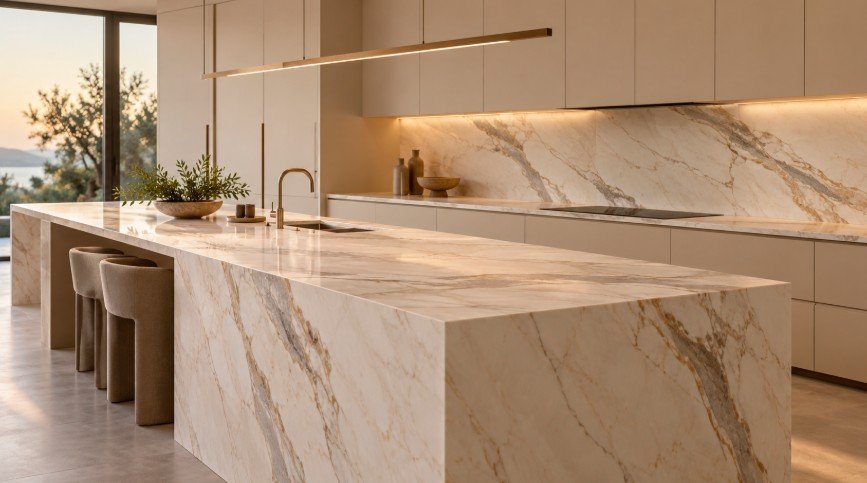
Warm veined marble countertop with waterfall ends and a matching backsplash
Natural stone, classic

Marble Countertops

Marble countertops create a classic and elegant appearance that is often associated with luxury kitchens.

Natural marble is known for its distinctive veining, soft movement, and refined appearance. Popular varieties include white marble with gray veining as well as warmer stones with beige, gold, or dramatic dark patterns.

Because marble is a natural material, every slab is unique.

Marble does require more careful maintenance than some other countertop options. It can be more susceptible to staining, scratching, and etching from acidic substances.

For homeowners who appreciate the natural aging and character of stone, marble can be a beautiful choice for kitchen islands, baking areas, statement countertops, or complete kitchens.

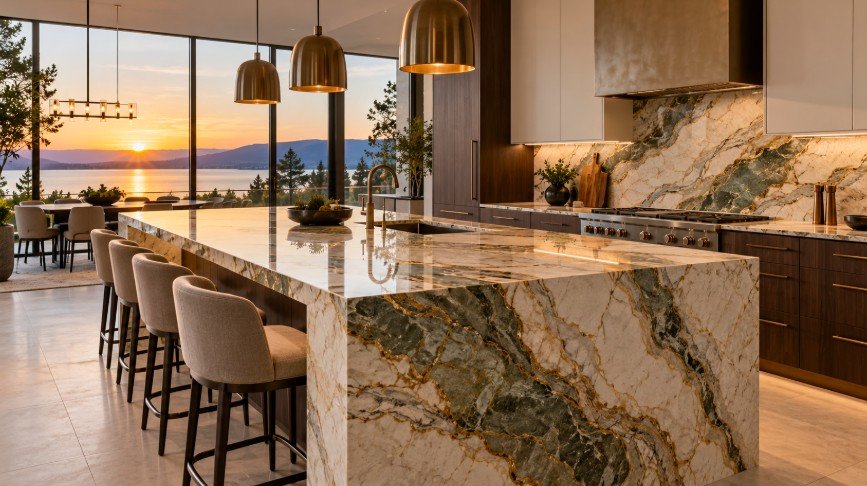
Quartzite waterfall island with dramatic green and gold veining
Natural stone, upscale

Quartzite Countertops

Quartzite is a natural stone countertop material known for its strength and striking appearance.

Many quartzite slabs feature elegant veining that resembles marble while offering different performance characteristics.

Quartzite can range from soft white and gray tones to warmer beige, green, blue, and dramatic multicolored patterns.

Because it is a natural stone, each slab has individual variation.

Quartzite is often selected for upscale kitchen remodels where homeowners want the character of natural stone combined with a durable work surface.

Like many natural stones, quartzite may require sealing and appropriate maintenance.

Slab selection is especially important because color, veining, and movement can vary considerably from one piece to another.

Heat and stain resistant

Porcelain Countertops

Porcelain countertops are becoming increasingly popular in modern kitchen design.

Porcelain is manufactured at high temperatures, creating a dense and durable surface that can resist heat, moisture, stains, and everyday wear when properly installed.

Porcelain slabs are available in many designs, including patterns that resemble marble, concrete, stone, and other premium materials.

Large-format porcelain can also create a clean, contemporary appearance with minimal visual interruption.

Because porcelain is available in thinner profiles than some traditional stone countertops, it can work particularly well in modern or minimalist designs.

Proper fabrication and installation are important because porcelain requires specialized cutting and handling techniques.

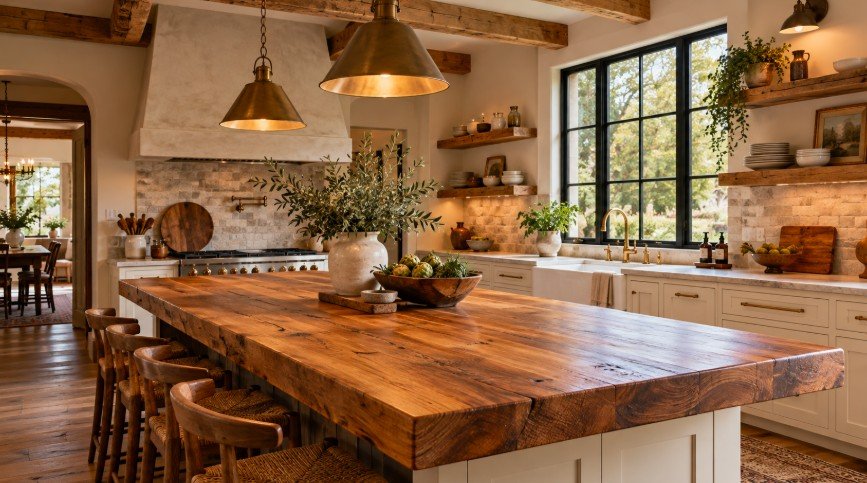
Thick reclaimed wood butcher block countertop on a kitchen island
Warm hardwood

Butcher Block Countertops

Butcher block countertops bring warmth and natural texture into a kitchen.

They are typically constructed from strips of hardwood joined together to create a solid work surface.

Common wood choices can include maple, walnut, oak, and other hardwoods.

Butcher block can be used throughout the kitchen or as an accent material on an island, baking station, coffee bar, or serving area.

Wood countertops require regular maintenance and appropriate protection from moisture.

Depending on the desired appearance, butcher block may be sealed, oiled, or finished using products suitable for kitchen surfaces.

The natural grain and warmth of wood can complement white cabinets, painted cabinetry, natural wood kitchens, and mixed-material designs.

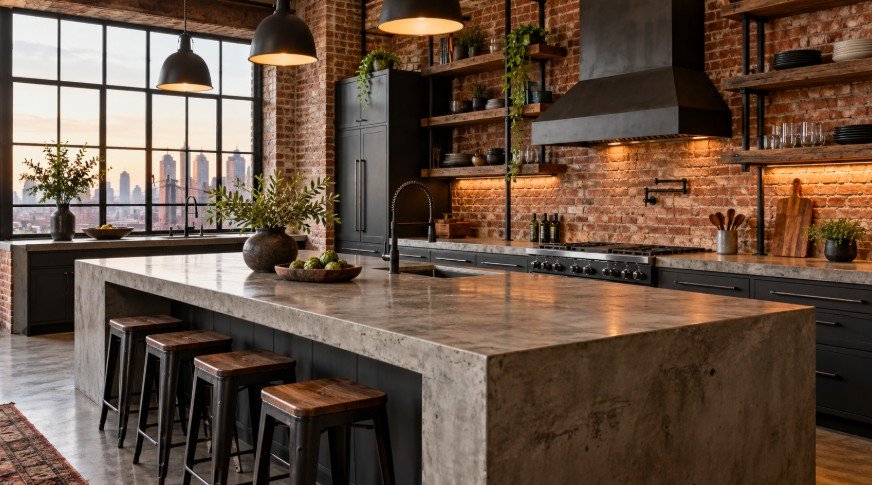
Concrete waterfall countertop in an industrial loft kitchen
Custom, architectural

Concrete Countertops

Concrete countertops offer a distinctive architectural appearance and can be customized in many ways.

They can be formed in different sizes, thicknesses, colors, textures, and edge styles.

Concrete can work especially well in industrial, modern, contemporary, and custom kitchen designs.

Pigments, aggregates, decorative elements, and specialty finishes can be incorporated to create a unique surface.

Because concrete is porous, it generally requires proper sealing and maintenance.

It may also develop small imperfections or natural variations over time, which some homeowners consider part of the material's character.

Concrete countertops can be particularly effective on large kitchen islands or in spaces where a handcrafted, custom appearance is desired.

Seamless look

Solid Surface Countertops

Solid surface countertops are manufactured from acrylic or similar materials to create a smooth, consistent work surface.

They are available in a wide range of colors, patterns, and finishes.

One advantage of solid surface materials is the ability to create relatively seamless-looking installations, depending on the layout and fabrication.

Integrated sinks and curved details may also be possible with certain solid surface systems.

These countertops can work well in modern, transitional, and practical family kitchens.

Minor surface scratches can sometimes be repaired or refinished, depending on the product.

Solid surface countertops can provide a clean appearance while offering more design flexibility than some traditional countertop materials.

Budget friendly

Laminate Countertops

Laminate countertops remain a practical option for homeowners who want a wide range of colors and patterns at a more accessible price point.

Modern laminate products are available in designs that imitate stone, wood, concrete, and other materials.

They can work well in rental properties, secondary kitchens, budget-conscious renovations, laundry areas, and smaller remodeling projects.

Laminate countertops are relatively lightweight and can often be installed over standard cabinet systems without the structural considerations required for heavier stone slabs.

Proper fabrication is important around sinks, seams, corners, and edges because moisture can damage the underlying material if water reaches exposed areas.

With thoughtful design, laminate can provide an attractive and functional kitchen surface.

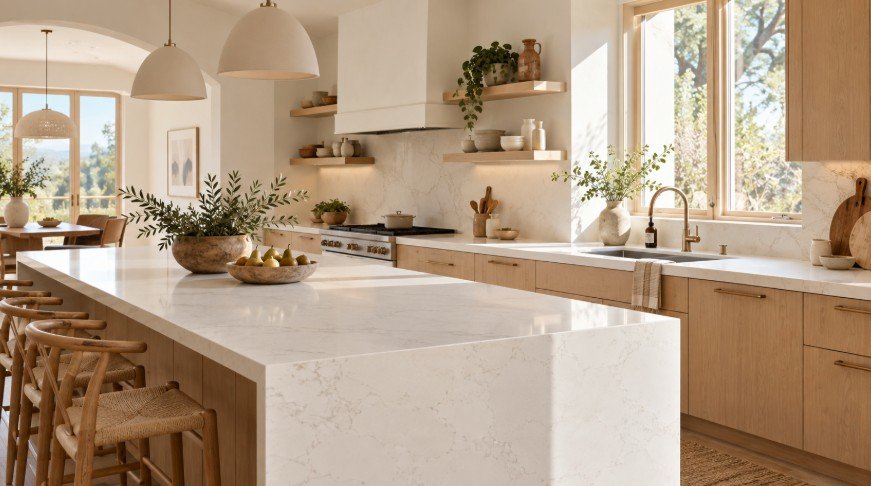
White quartz waterfall countertop wrapping the end of a light oak island

Waterfall Countertops

A waterfall countertop extends vertically down one or both sides of an island or cabinet run, creating a dramatic continuous surface.

This design is especially popular in modern and luxury kitchens.

Quartz, marble, quartzite, porcelain, and other slab materials can be used to create waterfall edges.

Careful fabrication is important because the pattern and veining should align visually between the horizontal surface and vertical panel whenever possible.

A waterfall design can also protect the side of the island while creating a strong architectural focal point.

It works particularly well with large kitchen islands, open-concept layouts, minimalist cabinetry, and statement stone with bold veining.

Large kitchen island with a thick warm-toned stone countertop and woven stools

Kitchen Island Countertops

Kitchen island countertops are often larger and more visually prominent than standard perimeter countertops.

Because the island may serve as a preparation area, dining space, entertaining zone, appliance station, or central gathering place, its countertop needs to be planned carefully.

Material selection should consider durability, appearance, maintenance, seating, sink or cooktop locations, electrical outlets, and countertop overhangs.

Large islands may require multiple slabs or carefully placed seams depending on the material and dimensions.

Homeowners may choose the same countertop material as the perimeter cabinets or select a contrasting material to make the island a focal point.

Waterfall edges, thicker profiles, rounded corners, and decorative edge details can further customize the design.

Countertop Repair

Some countertop damage can be repaired without replacing the entire surface.

Common problems can include chips, cracks, loose seams, minor scratches, damaged caulking, staining, edge damage, or separation around sinks.

The appropriate repair method depends on the countertop material and the severity of the damage.

Quartz, granite, marble, solid surface, laminate, wood, and concrete all require different repair techniques.

In some cases, minor damage can be filled, polished, refinished, resealed, or stabilized.

More severe structural damage may require partial or complete replacement.

An evaluation can help determine whether repair is practical or whether installing a new countertop would provide a better long-term result.

Countertop Edge Profiles

The edge profile can subtly change the overall style of a countertop.

Simple eased edges create a clean, contemporary appearance. Beveled edges can add definition, while rounded profiles provide a softer look.

More decorative edge treatments may be used in traditional or luxury kitchens.

Countertop thickness and material affect which edge profiles are possible.

Some designs use laminated edges to create the appearance of a thicker slab.

Waterfall sides and mitered edges are often selected for large islands and modern kitchens.

The edge should complement the cabinet style and overall design rather than competing with other decorative elements.

Marble countertops paired with sage green cabinets and brass hardware

Choosing the Right Countertop Material

Choosing a countertop material involves balancing appearance, durability, maintenance, budget, and lifestyle.

A household that cooks frequently may prioritize stain resistance and easy cleaning. A luxury remodel may focus more heavily on natural stone appearance, unique slab movement, and premium detailing.

Homeowners should also consider how the countertop coordinates with cabinet color, backsplash, flooring, lighting, and hardware.

Light countertops can make a kitchen feel brighter, while darker surfaces can create contrast and depth.

Bold veining can become a design feature, while subtle patterns may create a calmer appearance.

Reviewing actual samples or full slabs can help homeowners understand color variation and pattern before making a final selection.

Black and gold marble countertop continuing up the wall as a full-height slab backsplash

Countertop Backsplash Coordination

Countertops and backsplash materials should be planned together because they occupy adjoining surfaces and strongly influence the overall kitchen design.

A dramatic countertop may work best with a simpler backsplash, while a subtle countertop can allow a patterned or textured backsplash to become the visual focus.

Homeowners can choose tile, slab stone, quartz, porcelain, glass, marble, or other materials.

Full-height slab backsplash installations can create a seamless and luxurious appearance, especially when the pattern continues from the countertop onto the wall.

The design should also consider outlets, range hoods, windows, upper cabinets, shelving, and under-cabinet lighting.

Completed kitchen remodel with a marble waterfall island and coordinated cabinetry

Countertops for Full Kitchen Remodeling

During a full kitchen remodel, countertop selection should be coordinated with cabinet design, plumbing, electrical work, appliances, backsplash, and flooring.

Countertops are generally measured after the base cabinets are installed because accurate final dimensions are essential.

Sink type, faucet placement, cooktop openings, appliance clearances, and island dimensions should already be established before fabrication.

Planning these details early helps prevent unnecessary changes later.

The countertop can also influence the entire color palette of the kitchen.

Many homeowners select a stone or quartz pattern first and coordinate cabinet colors, backsplash, flooring, and hardware around it.

Upgrade Your Kitchen with New Countertops

New countertops can transform a kitchen even when the overall layout remains unchanged.

A carefully selected surface can brighten the room, modernize older cabinets, create a luxury focal point, and provide a more practical workspace.

Whether you prefer the consistency of quartz, the natural character of granite, the elegance of marble, the dramatic appearance of quartzite, or the warmth of butcher block, the right material should support both your design preferences and everyday use.

LA Kitchen Remodeling and Renovation can help plan countertop installation, replacement, material selection, island surfaces, waterfall edges, sink openings, and other details as part of your kitchen remodeling project.

The goal is to create a countertop system that looks beautiful, functions properly, and coordinates naturally with the rest of your kitchen.

Call (323) 345-4855

Get a Free Countertop Estimate

Tell us about your kitchen. We reply within one business day.

By submitting this form, you agree to our Privacy Policy.